
In 2011,Katrina Lake founded Stitch Fix- an online personal styling service company in the United States. The purpose was to provide customer personalized recommendations of clothes, shoes and accessories. Stitch Fix sold $730 million worth of clothing in 2016 and $977 million worth in 2017 (Katrina Lake,2018).
What is the initial motive?
With the rise of e-commerce in 2007, Katrina Lake thought about the influence it could bring to the retail. Fairly enough, the traditional physical stores are not effective enough as it takes customers 10 years before they can get a jean that suits them. Katrina Lake also doubted the effectiveness of today’s e-commerce model-customers could browse over 10 websites simultaneously despite the energy spent on keeping an eye on comments given by other shoppers. Therefore, she tried to bridge the gaps between the traditional model and the e-commerce model with the help of data science.
How the company operates?
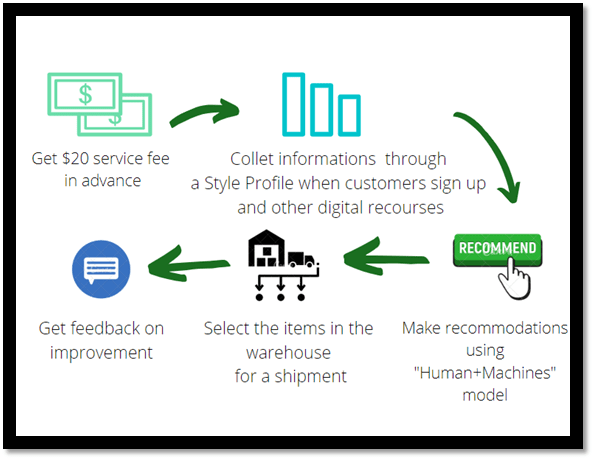
Once received $20 from customer, Stitch Fix send them 5 items that they think customers will like, then the customers can either keep the items they want or send them back. If they failed to keep any item, they are invited to give insightful feedback directly to stylists, to receive better service provided to her next time but others as well.
“Human+Machines” bueiness model
The key to Stitch Fix’s success is to make unique and personal selections by combining data and machine learning with expert human judgment.
In terms of data collection, this is achieved through a Style Profile (keeps updated) that filled out by customers when they first signs in, and through collaborations with social media platforms such as Pinterest, which allows customers to add photos of fashion looks that they like as well as other resources to get access to customer’s individual information. After the data collected, they were passed to data scientists to effectively and efficiently carry out analysis, write their algorithms, and put them into production.

While algorithmic approach is not always perfect, as shopping is inherently a personal and human activity (Katrina Lake,2018). There are some individual requests that may not be probed or fully understood by machine.
For example, when customer ask a look for specific occasions such as wedding or interview, instead, the stylists immediately know what dress options might work for that event. In addition, clients may also reveal personal information such as losing weight or being in an relationship, all which could be better served by human being rather than machine as stylists know better about what these mean to our clients and connect with client, and even improvise when needed.
Challengies the Stitch FIX faced with
Till 2019, Stitch Fix have more than 2 million active clients in the United States, and we carry more than 700 brands. however, problems keep coming up as the company grows and expands, which, need to be tackled in the future for the sustainable development of the company.
Even though Stitch Fix try every means they can to predict what products that can satisfy their clients, still, it is very likely that their clients will be disappointed after they receive the box and will make some negative comments online. And without any doubt, the power of word of mouth and fast-spreading of news on social medias can bring persistent negtive effects on Stitch Fix. How to satisfy their clients is and will continuous to be the biggest challenge for Stitch Fix in the years to come.

This happens because their high expectations at the very first beginning. As Stitch Fix promised to solve “I have nothing to wear” problem while helping you to style new pieces and looks. Customers always want something that surprised them even though sometimes customer themselves do not know what exactly they want. Secondly, customer get tricky simply because they do not want to waste $20 they spent in advance.
Inventory depletion through customer demand must ultimately be offset by purchases of new inventory. One of the challenges is in getting the timing of purchases right, so that we maintain adequate inventory availability for stylists while minimizing the sum of ordering costs and carrying costs (the operation costs and opportunity costs of capital associated with the area under the inventory curve).
Another challenge Stitch Fix is facing in terms of inventory is that they must also allocate inventory appropriately to different warehouses, and occasionally donate old inventory to make room for new styles (Eric Colson, Brian Coffey, Tarek Rached and Liz Cruz).
Others show concern about Stitch Fix as well. “Stitch Fix is doing a lot to drive its sales through the expansion into new product categories but for the time being they are lower margin due to sub-scale,” said Wells Fargo, which lists the many actions associated with new business segments that will incur costs, including warehousing and distribution.
Reference List
- Katrina Lake (2018) Stitch Fix’s CEO on Selling Personal Style to the Mass Markethttps://hbr.org/2018/05/stitch-fixs-ceo-on-selling-personal-style-to-the-mass-market
- Multithreaded AIgorithm tourhttps://algorithms-tour.stitchfix.com/
- Daniel Newman(2019) Stitch Fix: A Useful Case Study For Retail’s Digital Transformationhttps://www.forbes.com/sites/danielnewman/2019/09/09/stitch-fix-a-useful-case-study-for-retails-digital-transformation/#4e2b63107d4c
- Abi Khait(Aug 21,2019)Stitch Fix: Remote Styling Still Faces Major Problemshttps://www.updateyourstyle.com/post/stitch-fix-remote-styling-still-faces-major-problems
- Connie Chen (Apr 17, 2019)The evolution of Stitch Fix: from a Harvard student’s apartment to a $2 billion companyhttps://www.businessinsider.com/stitch-fix-personal-styling-overview?r=US&IR=T
- Tonya Garcia(June 8, 2019)Stitch Fix is on a growth trajectory — here are two reasons whyhttps://www.marketwatch.com/story/stitch-fix-is-on-a-growth-trajectory—-here-are-2-reasons-why-2019-06-06
 Coco's Blog