This is Chen Chen from China, just feel free to call me coco. I am currently majoring in MSc Marketing at the University of Exeter. I have graduated from the South West Minzu University with a bachelor degree in English, which means I had never learned knowledge about marketing until few months ago, let alone learning or blogging online, but I am interested in them.
I chose this course mainly because digital model is an important part in marketing and is getting more and more important nowadays, in order to better understand how digital models works and try to turn it into my advantage in terms of my future learning and working.
This module allows me to acknowlege a new model of learning,I have learned more about digital marketing and communicating. the use of MOOC and blog provide me an excellent chance to communicate with a wide range of people which can influence my future learning habit as well.
#The blog comments
Reading the blogs of my fellow students and commenting on them added much to my knowledge about different topics and, additionally, to my ability to research a topic which is unfamiliar to me.
#Comment 1
In my first comment on Daria’s blog about Data Mining technology, through Daria’s blog I learned how well this technology is used. To discover more I searched more on Data Mining technology and have a better understanding on this. I also added some information as my comments to help others who might have the same questions as me.
#Comment2
My next comment was on Ysheir’s blog concerning AI used in kitchen. I personally curious about this since this is something closely connected with our daily life and I find it necessary to know more about it to keep notice of what is going to happen in our future restaurant tour.
Luckily, I once went to some restaurants and witnessed how they take AI in their best use. Therefore, I shared my own experience as well as news I heard in my comments.
#Comment 3
Then Rainee’s blog about three secrets for Amazon’s success. As she compared Amazon with Taobao, and I use both frequently and have a lot to say on this topic, however, it would be better if take it less personally and focus more on how these two companies runs and their advantages.
#Comment 4
Finally, Kimmy’s blog about online therapy is the one that I concerned most and learned a lot from especially under current situation when a lot countries suffered from Covid-19.
Now we know that online therapy is an effective solution used by many countries to fight the epidemic as it breaks the board of time and place. But the next step should be improving the correctness of online therapy and making it more efficient in the future.
#Debate
On the debate raised by our lecturer on the change of our understanding of the circular economy, I mentioned how I was shocked by Dame Ellen MacArthur’s speech and the influence it left on me.
In 2011,Katrina Lake founded Stitch Fix- an online personal styling service company in the United States. The purpose was to provide customer personalized recommendations of clothes, shoes and accessories. Stitch Fix sold $730 million worth of clothing in 2016 and $977 million worth in 2017 (Katrina Lake,2018).
What is the initial motive?
With the rise of e-commerce in 2007, Katrina Lake thought about the influence it could bring to the retail. Fairly enough, the traditional physical stores are not effective enough as it takes customers 10 years before they can get a jean that suits them. Katrina Lake also doubted the effectiveness of today’s e-commerce model-customers could browse over 10 websites simultaneously despite the energy spent on keeping an eye on comments given by other shoppers. Therefore, she tried to bridge the gaps between the traditional model and the e-commerce model with the help of data science.
How the company operates?
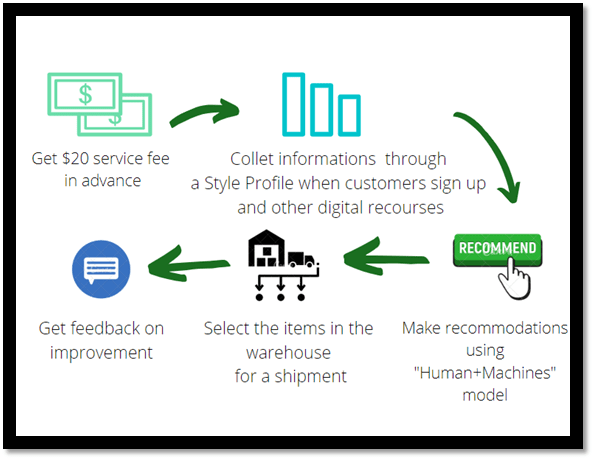
The Stitch Fix operational process (Infographic created on Canva.com)
Once received $20 from customer, Stitch Fix send them 5 items that they think customers will like, then the customers can either keep the items they want or send them back. If they failed to keep any item, they are invited to give insightful feedback directly to stylists, to receive better service provided to her next time but others as well.
“Human+Machines” bueiness model
The key to Stitch Fix’s success is to make unique and personal selections by combining data and machine learning with expert human judgment.
In terms of data collection, this is achieved through a Style Profile (keeps updated) that filled out by customers when they first signs in, and through collaborations with social media platforms such as Pinterest, which allows customers to add photos of fashion looks that they like as well as other resources to get access to customer’s individual information. After the data collected, they were passed to data scientists to effectively and efficiently carry out analysis, write their algorithms, and put them into production.
A quiz within the Style Profile
While algorithmic approach is not always perfect, as shopping is inherently a personal and human activity (Katrina Lake,2018). There are some individual requests that may not be probed or fully understood by machine.
For example, when customer ask a look for specific occasions such as wedding or interview, instead, the stylists immediately know what dress options might work for that event. In addition, clients may also reveal personal information such as losing weight or being in an relationship, all which could be better served by human being rather than machine as stylists know better about what these mean to our clients and connect with client, and even improvise when needed.
Challengies the Stitch FIX faced with
Till 2019, Stitch Fix have more than 2 million active clients in the United States, and we carry more than 700 brands. however, problems keep coming up as the company grows and expands, which, need to be tackled in the future for the sustainable development of the company.
Even though Stitch Fix try every means they can to predict what products that can satisfy their clients, still, it is very likely that their clients will be disappointed after they receive the box and will make some negative comments online. And without any doubt, the power of word of mouth and fast-spreading of news on social medias can bring persistent negtive effects on Stitch Fix. How to satisfy their clients is and will continuous to be the biggest challenge for Stitch Fix in the years to come.
Negtive comments posted online by the clients
This happens because their high expectations at the very first beginning. As Stitch Fix promised to solve “I have nothing to wear” problem while helping you to style new pieces and looks. Customers always want something that surprised them even though sometimes customer themselves do not know what exactly they want. Secondly, customer get tricky simply because they do not want to waste $20 they spent in advance.
Inventory depletion through customer demand must ultimately be offset by purchases of new inventory. One of the challenges is in getting the timing of purchases right, so that we maintain adequate inventory availability for stylists while minimizing the sum of ordering costs and carrying costs (the operation costs and opportunity costs of capital associated with the area under the inventory curve).
Another challenge Stitch Fix is facing in terms of inventory is that they must also allocate inventory appropriately to different warehouses, and occasionally donate old inventory to make room for new styles (Eric Colson, Brian Coffey, Tarek Rached and Liz Cruz).
Others show concern about Stitch Fix as well. “Stitch Fix is doing a lot to drive its sales through the expansion into new product categories but for the time being they are lower margin due to sub-scale,” said Wells Fargo, which lists the many actions associated with new business segments that will incur costs, including warehousing and distribution.
I am keen on art since I was young. And based on my study background in Marketing, I was hoping that I can work for a museum back in China as a marketer one day. Art is and will continuously play an increasingly important role in the life of Chinese.
This is because as the physical life of Chinese gets better, they have more energy and money to be spent on having fun on their leisure time and on enriching their spiritual world. Visiting museums more frequently seems an optical choice as it provides an excellent chance for them to maintain close contact with different works of masters, so as to grow aesthetic ideas and to grow historical knowledge.
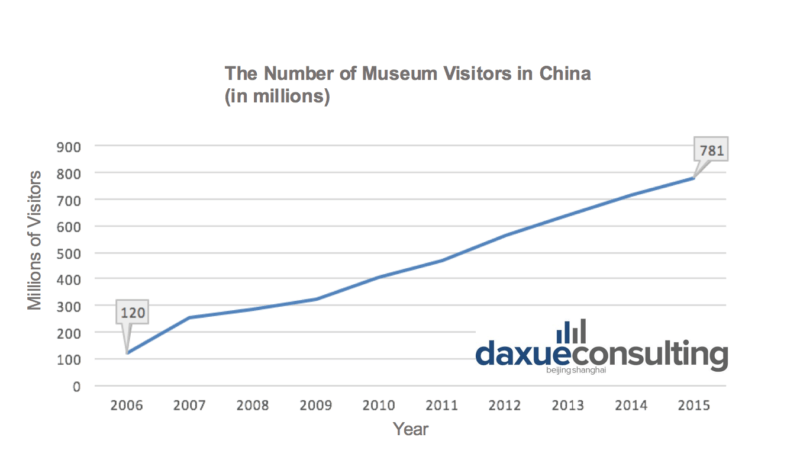
According to the National Bureau of Statistics of China, the number of museum visitors rising from 120 million in 2006 to approximately 781 million in 2015.
When it comes to marketing for museum, there is a lot to consider. For example, how to uphold a strong brand image, how to maintain closely relationships with customers, and how to differentiate your brand with competitors. As we are now living in a world of digital economy, there are a lot of advanced digital techniques that are taken into good use for marketing for museums as a marketer.
Firstly, the flexible use of official Wechat account- a feature on a popular social media app Wechat which are over 90% downloaded by Chinese who possess a smartphone. App users get information about exhibitions and museums directly through their official accounts and buy tickets by scanning the QR code linked at the button of the article. What is more, there are rooms for people to exchange opinions freely among hot topics with whoever follow the same official account and introductions about innovative stuffs and places that might interest them, so as to build a closer relationship with customers as a ‘touchpoint’, more specifically, the more frequently people check the official account, the more likely people will pay a visit to the museum recommended.
As the example posted above, this is an official Wechat account named Mars, in which includes five main features: Insider, Guide, Choice, News, Topic. With the help of official account, the museum can access what Tencent now over 1151 million total users on WeChat.
Secondly, the extensive application of AI (Artificial intelligence)-a powerful tool used to attract more audience by increasing visitor experience and to better integrate resources by forecasting the number of visitors.
Berenson and Pepper are two human-like robots that are used to interact with visitors, with Berenson being able to change the color of eye and facial expression based on the feedback from visitors as it contains a camera in its eye, the color of its eye will turn to green and will smile if receiving positive reactions, while will turn to red and frown the opposite. Pepper, the upgrade version of Berenson, was used in different museums in U.S. with the purpose of answering people’s questions and telling stories with the help of voice, gestures and an interactive touch screen (Lauren Styx,2019).
Another way AI used to help marketing for a museum is to be proactive by predicting the number of people who fail to show up to collect tickets before the museum opens, as a consequence, the museum could decrease its actual capacity to open in order to eliminate potential loss.
In the future, as a marketer for museum, I should be more accustomed to digital business processes and virtual working as it is an inevitable trend. There are some digital tools that hopefully could be taken into practice to help satisfying and understanding our customers better.
An application named Museum Guide 2.0, which use a head mounted mobile eye tracker in combination with content-based image retrieval technology, according to its inventors, it acts like an unobtrusive personal guide of a visitor. When it detects the visitor is looking at a specific art object, the earphone visitor wears will play relevant audio information about it automatically, and the audio information changes alongside the visitor’s eye movement. Besides, this design could also be used to collect visitor’s preferences towards art works.
This would greatly help enhancing user experiences and making up for the lack of audio guides or commentators on specific holidays. Take my own visiting experience on Britain Museum few months ago, for example, which took me nearly an hour waiting in line to get an audio guide. With the help of this digital technology, hopefully, users can save time as well as better enjoy themselves on the museum.
Because of the development of ICT, as a marketer nowadays, one of the most important ability I need to be equipped with is to integrate all type of information and formulate a scheme about what is best suitable for the future of the museum.
References:
Gisbergen, S. B. (n.d.). When Sound Modulates Vision: VR Applications for Art and. Academy for Digital Entertainment.
Is affordable art the next big consumer trend in China? (April 24, 2014).
Styx, B. L. (March 28 2019). How are museums using artificial intelligence, and is AI the future of museums?
The future of work jobs and skills in 2030. (n.d.).
Xia, Li. (2018). Across China: “Immersive” exhibitions become hot trend in China.






 Coco's Blog